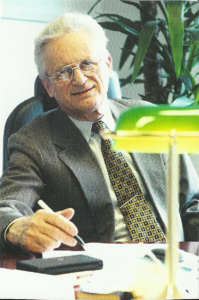
Tamás Magay at work in his office. Photo courtesy of the Magay family.
We are deeply saddened to announce that Dr Tamás Magay passed away peacefully on 28 February 2026. His departure is an immeasurable loss not only to Hungarian linguistics but to the entire lexicographic community. Even in his final years, he continued to work on dictionary projects with the same dedication and scholarly precision that characterised his long and influential career.
Dr Magay’s scholarly legacy has shaped the development of modern Hungarian and European lexicography. His career represents a significant chapter in the discipline’s history. He began his higher education at Pázmány Péter University and Eötvös Collegium. He later continued his studies as a scholarship holder at the University of Edinburgh, an experience that broadened his intellectual horizons and deepened his engagement with the English language and culture. After returning to Hungary, he pursued theological studies at the Reformed Theological Academy between 1949 and 1953, before shifting his focus back to English linguistics. He earned his degree in English linguistics at Eötvös Loránd University in 1961. He went on to complete his doctorate there in 1964, marking the beginning of a distinguished scholarly path in lexicography and language studies.
In the 1950s, he worked as a translator at the Central Research Institute for Physics, and in 1957, he joined the Dictionary Editorial Department of the Akadémiai Kiadó (Hungarian Academy of Sciences’ publishing house). Working for several decades alongside László Országh, he played a major role in shaping the direction and standards of Hungarian lexicography. His second career, as a university professor, spanned the years between 1993 and 2001. During this time, he established the English Department (now the Institute of English Studies) at Károli Gáspár University of the Reformed Church in Hungary and served as its first head. It was here that he introduced lexicography as a university‑level subject in Hungary, laying the groundwork for its academic teaching. He completed his habilitation in 1996, closing a significant chapter of his academic career.
Over the course of his career, Dr Magay contributed to the compilation and editing of more than fifty bilingual dictionaries. These works, particularly the well‑known Országh–Magay English–Hungarian dictionaries, have supported generations of language learners and remain among the most respected bilingual dictionaries in Hungary today. His scholarly contributions extended far beyond dictionary making. Dr Magay conducted significant theoretical research, thereby advancing both the Hungarian tradition of dictionary studies and European lexicographic scholarship. He was also a founding member of EURALEX, helping to establish a professional forum that continues to unite lexicographers across Europe. As a founding member of the association, he played a central role in building a vibrant professional network that connected lexicographers across Europe. His commitment became especially visible when Budapest hosted the 1988 BudaLEX Congress, the third EURALEX International Congress, of which he was the chief organiser. Colleagues who first met him there – often as young scholars – recall him as an open, generous, and deeply knowledgeable mentor, always ready to discuss questions of vocabulary selection, dictionary structure, user needs, and the emerging challenges of computational lexicography. Over the years, his presence at EURALEX events became a defining point of continuity: he regularly attended congresses, engaged thoughtfully in scholarly debates, and cultivated international collaborations and friendships that shaped the field. His belief in nurturing the next generation was equally influential; his 2000 EURALEX paper on teaching lexicography famously called attention to the need for structured training programmes, a vision that later contributed to the creation of the European Master in Lexicography (EMLex). For many within EURALEX, he embodied the society’s intellectual spirit, deeply rooted in tradition, yet fully attentive to innovations in computational methods and language technology. His legacy within the association remains profound.
His work was recognised with numerous Hungarian and international distinctions, including the Verbatim Award (1997), the Országh László Prize (1997), the Apáczai Csere János Award (2001), and the Pro Universitate Award (2007). In 2019, he received the Hungarian Order of Merit, Knight’s Cross. For many years, he served as an external consultant to the Oxford English Dictionary, overseeing the accuracy of entries relating to Hungary and the Hungarian language.
Those who knew him remember him as a scholar of rare precision, quiet wisdom, and intellectual generosity. His life’s work – tens of thousands of pages of lexicographic work, the institutional foundations he built, and the many students he taught and mentored – reflects his unwavering dedication to language, lexicography, teaching, and scholarly service.
His legacy lives on in his dictionaries, in the knowledge of his students, and in the international lexicographic community that continues to benefit from his contributions.
We honour his memory with deep respect and gratitude.
Katalin P. Márkus and Pődör Dóra, 03 March 2026